26. October 2026


Autonomous-driving research depends on data. New machine-learning models must be trained and evaluated against large volumes of real-world data before researchers can determine how well they will perform outside the lab. But research vehicles operating on public roads inevitably capture people, license plates and other identifiable information, and publishing that data raises real privacy concerns, particularly in Germany, under the European Union’s General Data Protection Regulation (GDPR) and German data-protection law, which set a high bar for what counts as truly anonymized data.

Customer
Institute for Measurement and Control Technology (MRT)

Milestone products
brighter AI anonymization

Integrations
N/A

Location
Karlsruhe, Germany

Camera count
N/A

Partner
N/A
The Institute for Measurement and Control Technology (MRT) in Karlsruhe, Germany developed KITScenes, a new autonomous-driving dataset intended to provide researchers with high-fidelity data from European roads. MRT wanted the dataset to reflect the real world closely enough to support advanced machine-learning research. At the same time, the team needed a way to address the privacy risks associated with faces and license plates appearing in camera imagery. To reconcile those requirements, MRT turned to brighterAI, now part of Milestone Systems, using its anonymization technology to replace identifiable faces and license plates while preserving the visual realism that makes the underlying data valuable for research.
Challenge: Publishing Real-World Data While Protecting Privacy
MRT needed to anonymize faces and license plates captured by its research vehicle before it could publish the KITScenes dataset. At the same time, the team wanted to avoid conventional blurring that would alter the imagery and potentially affect its usefulness for machine-learning research. MRT therefore needed an anonymization approach that would help reduce the legal risk associated with publishing real-world sensor data while maintaining the quality of the dataset.
Solution: Anonymizing Faces and License Plates Without Blurring
MRT selected brighterAI for its inpainting approach. The solution detects faces and uses generative AI to replace them with different faces, while license plates are detected and replaced with randomly generated plates. This gave MRT an alternative to simple blurring that looked more realistic for machine-learning models. The team could also run the brighterAI models locally on its own GPUs rather than transfer the data over the internet.
Result: Enabling MRT to Publish KITScenes
With brighterAI, MRT was able to anonymize the camera imagery and publish KITScenes for non-commercial research use. In small-scale internal comparisons, people shown original and anonymized images generally could not tell which was which unless they zoomed in significantly or relied on an external clue. MRT was also able to process the data locally and scale the workload across its own GPU resources, with the vast majority of the processing completed within a few days.
Updating a Dataset for Today’s Autonomous-Driving Research
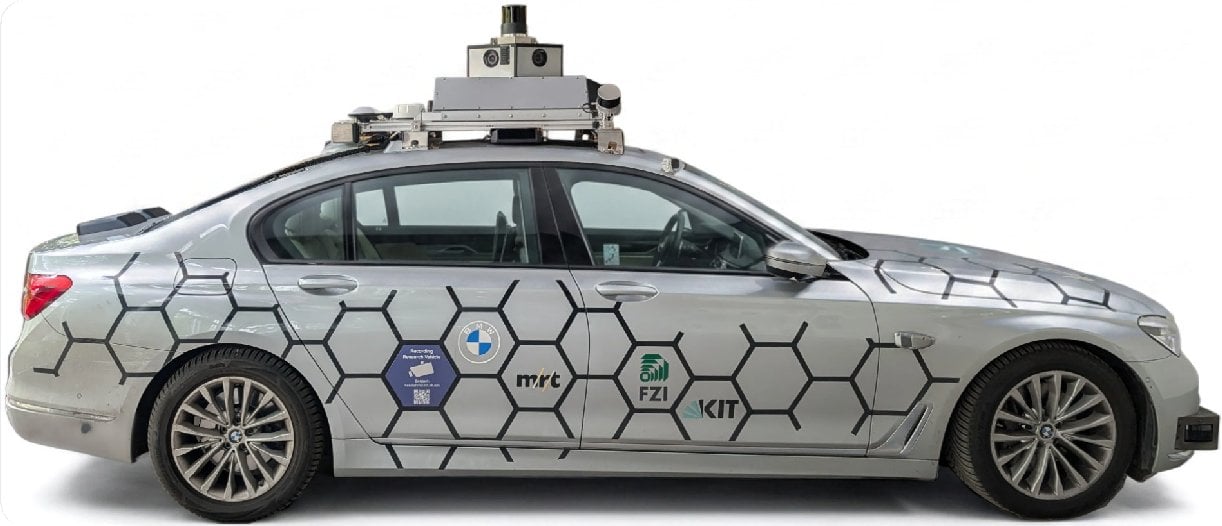
MRT has a long history in autonomous-driving research. Its work spans visual perception, planning and vehicle control, and the institute operates its own research prototype vehicle with permission to conduct autonomous test drives on public roads in Germany. MRT was also behind the KITTI dataset, released in 2011 and well known within the autonomous-driving research community.
By the time MRT began the KITScenes project, however, KITTI was roughly 14 years old. Cameras and other sensors had advanced significantly, and MRT saw a need for a new dataset that reflected those developments. The team also saw a geographic gap in the data available to researchers. Many newer datasets had been collected in the United States, and MRT’s own testing showed that models trained on them were not directly applicable to German roads, where layouts, structures and traffic signs can differ.
– Fabian Immel, PhD student and research scientist at MRT
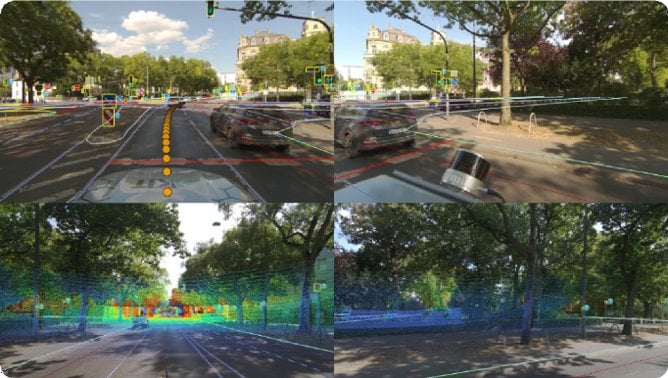
KITScenes was built around a high-fidelity sensor suite with high-resolution cameras, lidar and radar. MRT also created detailed high-definition maps in which elements such as lanes and traffic lights are annotated with centimeter-level accuracy. According to Immel, the goal was for the maps to contain enough information to support a map-based autonomous-driving software stack.
When Real-World Data Creates a Privacy Problem
The same public-road environment that makes the data valuable also creates a problem: cameras inevitably record people and vehicle license plates. Immel explained that privacy requirements have changed considerably since the earlier KITTI dataset was created, making publication of real-world sensor data more difficult.
For MRT, another complication was the uncertainty surrounding what constitutes sufficient anonymization. Immel noted that there is no official rule stating that, for example, blurring every face in an image automatically makes the data anonymized. That made keeping legal risk as low as possible an important consideration when the team planned KITScenes.
But MRT did not want to solve the privacy problem by simply obscuring large portions of its imagery. The dataset was intended to support machine-learning models that could later operate in real-world settings. Immel explained that if researchers trained models on imagery in which people or faces were consistently blurred, the models could overfit to that particular type of anonymization rather than seeing the visual information they would encounter in actual use.
– Fabian Immel, PhD student and research scientist at MRT
Replacing Identifying Information Instead of Blurring It
This requirement led MRT to brighterAI. Immel said brighterAI was the only company the team was aware of that offered this type of inpainting anonymization as a commercial product. Immel also said brighterAI had shown that its anonymization did not affect the performance of machine-learning models trained on anonymized data too much compared with non-anonymized images.
The fact that brighterAI was an established commercial provider also influenced MRT’s decision. Immel explained that university researchers might ordinarily look at the latest research and implement a solution themselves. With the legal considerations surrounding anonymization, however, MRT preferred to use an established commercial solution rather than rely entirely on something it had developed internally.
Keeping the Processing Local
MRT conducted small internal comparisons to see how noticeable the anonymization was. People were shown an original image and an anonymized version without being told which was which. Immel said participants generally could not identify the original unless they zoomed in significantly or noticed an external clue—for example, that a generated license plate did not correspond to the location where the image had been captured.
MRT was able to run the brighterAI models completely locally using its existing GPU resources. That meant the team did not need to transfer the original data over the internet for processing and could scale the workload across its own hardware when needed. Immel said the vast majority of the processing was completed within a few days.
The solution ran in Docker and provided a Python API. MRT’s unusual format—approximately 10-frame-per-second video represented as individual images—required some workarounds, and Immel said brighterAI was quick to help when questions arose.

Original

Looking Ahead
With KITScenes now published, MRT expects to continue working with the dataset. Immel said the team is considering activities such as research challenges as well as possible extensions to KITScenes, although no specific plans have yet been finalized. He also pointed to fine-tuning large foundation models for specific autonomous-driving tasks as a newer potential use for datasets of this kind.
Recognize the challenges?
Do you also need to see what is happening on your premises, so you can respond in time?
Get in touch with us at milestonesys.com/book-a-demo/ and let’s talk about what type of solution is right for you.
About Milestone Systems
Milestone Systems is a world leader in data-driven video technology used in industries as diverse as manufacturing, airports, law enforcement, retail, and traffic management. We provide a clear picture of how to create a safer, better and more prosperous world. Our XProtect video management software, BriefCam AI-powered analytics, and Arcules cloud VSaaS help our customers learn from the past, understand the present, and predict the future. Founded in 1998 and headquartered in Copenhagen, Milestone employs more than 1,500 people worldwide and has been an independent company in the Canon Group since 2014.

